Grammar
Sentence Structure
To-be Sentences (Descriptive)
Personal Descriptions:
- “The weather is beautiful today”
- “This coffee is too hot”
- “The students are very attentive”
Emotional States:
- “I am excited about the trip”
- “She is nervous before presentations”
Action Verb Sentences
Daily Activities:
- “The chef prepares amazing dishes”
- “Students submit assignments online”
Impact on Others: - “Your story inspires many people”
- “This music calms my nerves”
Tenses Review
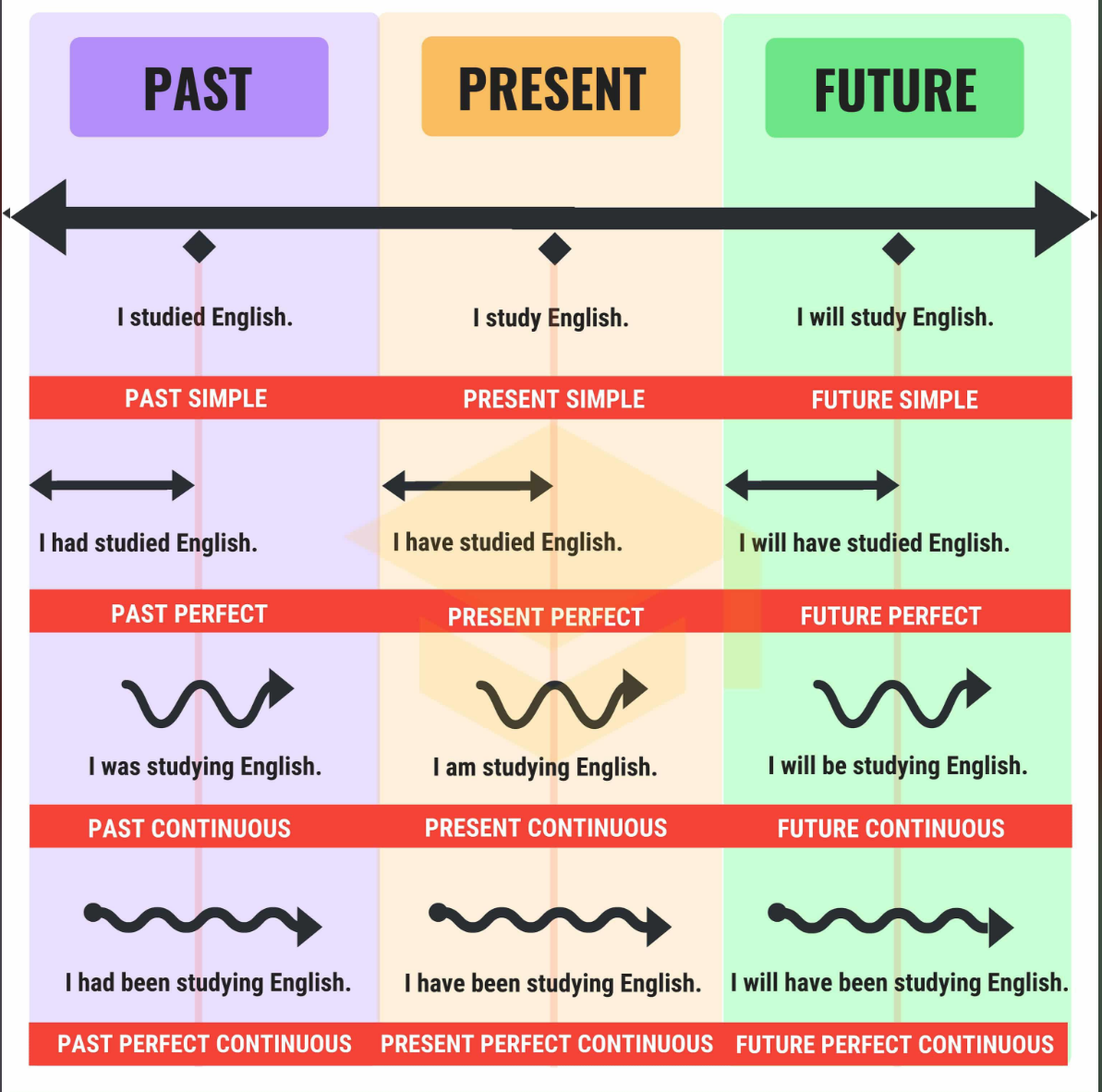
Here’s a detailed elaboration with contextual examples:
Present Tense
1. Schedules & Routines
Daily Life:
- “The bus arrives at 7:30 AM every morning”
- “My first class starts at 9:00 AM”
- “The cafeteria closes at 8 PM”
2. Universal Facts & Scientific Truths
- “The Earth revolves around the Sun”
- “Water freezes at 0 degrees Celsius”
- “Plants need sunlight to grow”
3. Personalities & Characteristics
Personal Traits
- “She speaks four languages fluently”
- “He excels at problem-solving”
Habits
- “They always arrive early to meetings”
- “She drinks green tea every morning”
Present Continuous
1. Current Actions (Right Now)
- “She’s preparing dinner right now”
- “We’re discussing the new project”
2. Ongoing Temporary Situations
Job Search
- “I’m looking for a new apartment”
- “We’re renovating our house”
Studies
- “She’s studying for her final exams”
- “They’re working on their thesis”
3. Complaints & Annoyances
Family Life
- “The neighbors are always playing loud music”
- “The kids are constantly fighting”
Work Situations
- “My colleague is always coming late”
- “The printer is forever breaking down”
4. Near Future Plans
Travel:
- “We’re flying to Paris next week”
- “They’re moving to Singapore next month”
Social Plans:
- “I’m meeting Sarah for coffee tomorrow”
- “We’re having dinner with the Johnsons tonight”
Present Perfect: Connecting Past to Present
1. Life Experiences
Travel:
- “I have visited five countries this year”
- “She has never been to Europe”
Achievements:
- “He has won three competitions since January”
- “They have published ten papers in their career”
2. Recent Actions with Current Impact
Work:
- “I have just finished the report”
- “We have already sent the email to the client”
Study:
- “I have completed all my assignments”
- “She has studied for six hours today”
3. Ongoing Situations
Life Changes:
- “I have lived in Tokyo for five years” (still living there)
- “They have worked together since 2018” (still working)
Relationships:
- “We have known each other since college”
- “She has been married for ten years”
Other Topics Mentioned
1. Transitive/Intransitive Verbs (Nội Động Từ / Ngoại Động từ)
2. Article (Mạo từ)
3. Conditional Sentences
Pronunciation
Vietnamese Vs English Pronunciation: Key Differences
1. Jaw Movement Differences
Vietnamese Characteristic:
- Minimal jaw movement (mostly lips and tongue)
- Shorter mouth opening
- More contained sounds
English Requirement:
- Exaggerated jaw movement needed
- Wider mouth opening for clear vowels
- Practice exercises:
- “BATH - BAT - BED - BAD”
- “SHEEP vs SHIP”
- “FOOL vs FULL”
2. Breath Control & Diaphragm Usage
- Vietnamese Speaking:
- Chest-level breathing
- Shorter breath units
- English Speaking:
- Deep diaphragmatic breathing required (Lấy hơi từ bụng)
- Longer breath units for stress patterns
3. Vowel Combinations
Vietnamese Challenge:
- Tendency to separate vowels
- Adding glottal stops between vowels
English Requirement:
- Smooth transitions needed
- Common combinations to practice:
- “ia” as in “material” /məˈtɪriəl/
- “ui” as in “fluid” /ˈfluːɪd/
- “oa” as in “boat” /bəʊt/
Practice Techniques
-
Mirror Practice:
- Watch jaw movement
- Monitor mouth openings
- Check tongue position
-
Recording Exercises:
- Record yourself reading
- Compare with native speakers
- Focus on problem areas
-
Daily Drills:
- Exaggerated jaw exercises
- Breathing exercises
- Vowel combination practice
- Two-step syllable awareness
-
Common Problem Words:
- “Think” vs “Sink”
- “Three” vs “Tree”
- “This” vs “Dis”
- “Thank” vs “Tank”
Take-away
1. Lấy Hơi Từ Bụng
Nguyên lý:
- Hơi phải đi từ bụng lên, không phải từ ngực
- Khi nói, bụng sẽ phình ra, không phải ngực
Cách kiểm tra:
- Đặt tay lên bụng khi nói câu có trọng âm:
- “I DON’T want to GO there”
- “This is ABSOLUTELY RIDICULOUS”
- Bụng sẽ rung mạnh ở các từ viết HOA
Bài tập:
- Hít sâu, để bụng phình ra
- Đọc to từng câu, cảm nhận bụng rung
- Tập nói to dần từ nhỏ đến lớn
2. Nối Âm
- Một âm tiết đa phần đều sẽ có 2 chuyển động, khi ghép các âm tiết cạnh nhau, thì sẽ tối giản được các chuyển động miệng (thường là lên/xuống) để nói mượt hơn.
Ví dụ:
- Fire ⇾ “Faaaa-ir”
- “What is it?” → “Whaaaa-tiiiiii-zit”
- “Turn on” → “Tɜ-non”
- “Pick up” → “Piiiii-kup”
3. Nhớ Sử Dụng Cằm
Điểm khác biệt với tiếng Việt:
- Tiếng Việt: Miệng hẹp, ít cử động cằm
- Tiếng Anh: Cần mở miệng rộng, cằm chuyển động nhiều
Các cặp âm cần luyện tập:
- SHIP vs SHEEP
- BIT vs BEAT
- PULL vs POOL
Bài tập trước gương:
- Đặt ngón tay dưới cằm
- Cảm nhận cằm di chuyển
- Tập mở miệng to hơn bình thường
4. Nguyên Âm Đôi Và Tính Đối Xứng
- Miệng phải đối xứng khi phát âm
- Chuyển động mượt mà, không đứt đoạn
Các cặp nguyên âm thường gặp:
-
“oʊ” như trong “boat”
-
“ai” như trong “fire”
Vocabulary
TLinh, Trung, Thanh
- lose count of sth
- lose face
- lose sight of
- be over the moon
- be on cloud nine
- quarrel
- open to dispute
- prerequisite
- rich ~ affluent ~ wealthy
- make ends meet
- poor ~ needy ~ impoverished
- misfortunate
- take a rain check (on something)
- you can say that again
- introvert
- extrovert
- yawn
- tone sth down
- irritated ~ annoyed
- photogenic
- economics
- resort to
- tone sth down
- photogenic
- manufacturer
- vendor